Discovering the Web Platform
By 2010, I was fully committed to software development. My early experiments with PHP and MySQL had led me naturally into the growing WordPress ecosystem, which at the time was rapidly transforming from a simple blogging platform into a full-fledged content management system.
I began building custom WordPress websites for small businesses, experimenting with themes, plugins, and integrations. Each project pushed me deeper into the platform's possibilities — from simple content sites to dynamic, database-driven applications.
Formal Training & Academic Foundations (2011–2013)
To strengthen my self-taught skills with academic rigor, I enrolled at the University of South Africa (UNISA). In 2013, I completed multiple certifications, passing with distinction:
- PHP & MySQL Certification — UNISA
- C#.NET Certification — UNISA
- C++ Programming — UNISA (curriculum component)
- Ethical ICT for Development — UNISA
This period marked the formal consolidation of my technical foundation. I moved from being primarily a business-driven problem solver to a developer with both academic training and practical experience.
The combination of business ownership (2000–2011), self-training (2009–2011), and formal study (2011–2013) created the perfect launchpad for the next chapter: global recognition in the WordPress and WooCommerce ecosystem.
WooCommerce and WooThemes
It wasn't long before my path intersected with WooThemes, a Cape Town–founded company that had launched WooCommerce, an open-source e-commerce plugin that would eventually become the backbone of millions of online stores.
In 2014, I became part of the Woo ecosystem as an official WooCommerce Support Ninja, providing direct support to a global user base. That role meant solving real-world problems daily: helping store owners configure payment gateways, debugging plugin conflicts, and advising developers on best practices.
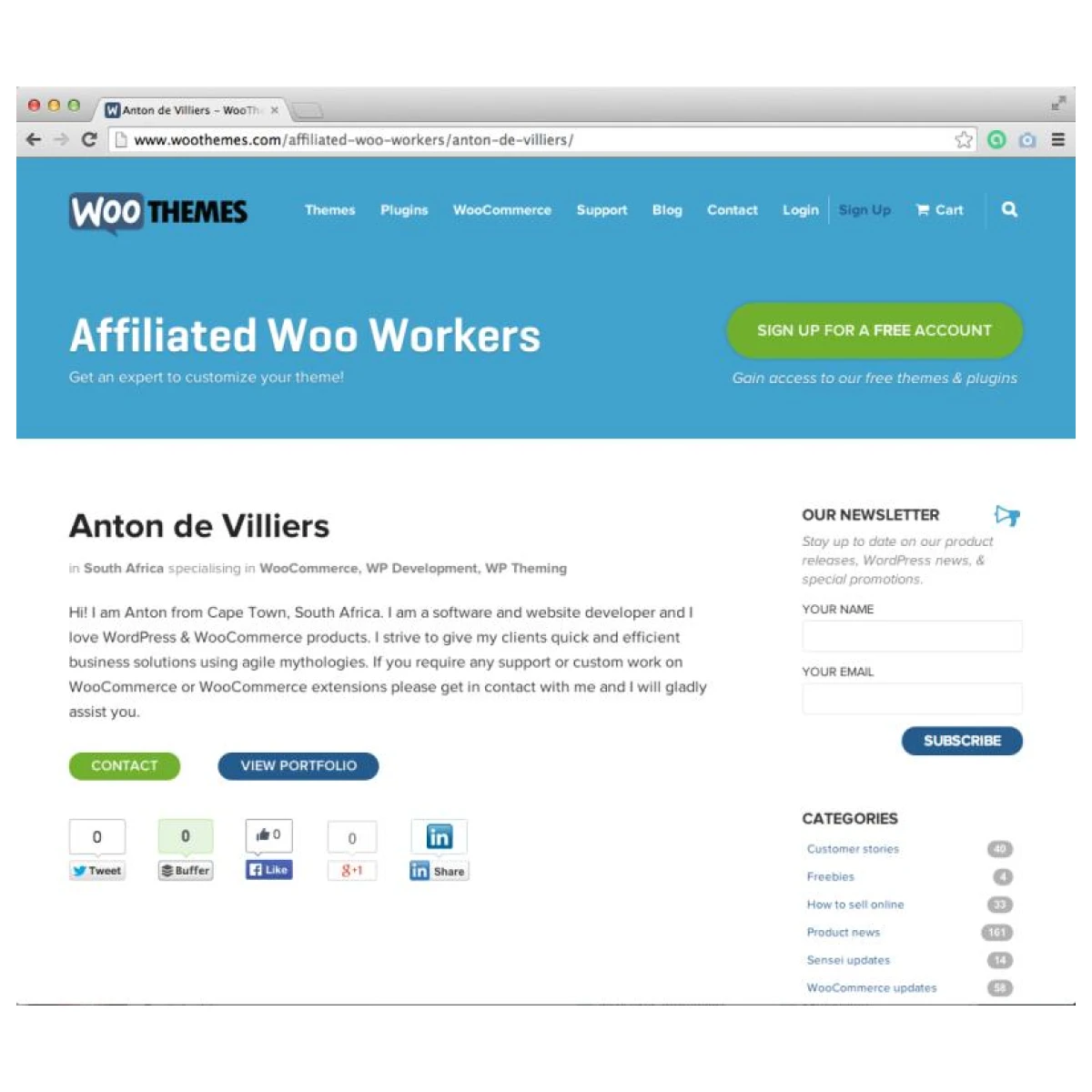
I was also listed publicly as a WooThemes Affiliated Woo Worker, a recognition that placed me among a select group of trusted developers worldwide who could be hired directly for WooCommerce projects. This affiliation carried weight — WooThemes itself recommended me to clients, which opened doors to international collaborations.
Skills Sharpened
Working within the WooCommerce ecosystem honed some of the skills I still use today:
- Problem-solving at scale. Supporting a global e-commerce community exposed me to every type of bug, hosting setup, and client need imaginable.
- Custom plugin & theme work. I built extensions, customized themes, and learned how to extend WordPress beyond its core.
- E-commerce logic. Inventory, carts, checkout flows, payment APIs — I gained an intimate understanding of what makes online stores succeed or fail.
Lessons Learned
This period also shaped my professional ethos:
- Be responsive. When someone's store is down, every minute counts.
- Communicate clearly. Many clients weren't technical, so translating complex issues into plain language became second nature.
- Go the extra mile. I built a reputation for not just fixing problems but explaining, documenting, and ensuring clients felt confident moving forward.
Paving the Way Forward
By the time WooThemes was acquired by Automattic (the company behind WordPress.com) in 2015, I had already cemented my identity as a WooCommerce expert developer. My affiliation as a Woo Worker and my work as a Support Ninja gave me global visibility, and clients began approaching me directly for more complex custom development.
And while this era is framed as 2010–2014, my work with WordPress and WooCommerce never stopped. Long after joining Codeable and moving into SaaS architecture, I continued delivering high-value projects on the platform, integrating WordPress and WooCommerce with APIs, CRMs, and enterprise systems.
This era laid the foundation for the next big leap: becoming a Certified Expert Developer on Codeable.io, where I could bring the same WooCommerce expertise to a much broader audience.